
VICTORY DAY
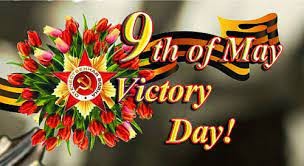
May 9 is called Victory Day, named to commemorate the victory in the Great Patriotic War (WWII), achieved by the people of the USSR over Nazi Germany. It is celebrated across the former Soviet Union countries. On May 9, 1945, after the war that lasted from 1941 to 1945, an act of unconditional and total capitulation of the Wehrmacht was signed. Participating in the signing were Deputy Supreme Commander-in-Chief Marshal of the Soviet Union Georgy Zhukov, Marshal of Aviation of Great Britain A. Teddar, representing the Allies, and Army General V. Kittel, the Chief of Staff of the Supreme Command of Germany.
By Stalin's decree, May 9 was declared a national holiday called Victory Day and became a day off. On the first Victory Day, joyful people with tears in their eyes congratulated each other on the victory, embracing and kissing. In the evening of May 9, a Victory Salute was fired in Moscow (it became the largest in the USSR — with 30 volleys from 1,000 guns). Three years later, a command to forget the war and Victory Day was issued: priority was given to restoring the national economy, which had suffered from the destructive war. The holiday was only restored in 1965, with Brezhnev’s era of leadership — from that moment on, the festive salutes and parades resumed. Europe also celebrated May 9, 1945, at least nationwide — almost every European city sounded congratulatory messages to ordinary people and soldiers.
May 9 is a day of celebrations, parades, salutes, but it also has other traditions and attributes:
• Floral and wreath laying at memorials and cemeteries. Both adults and children bring flowers to the memorial sites of WWII soldiers who died fighting for their homeland.
• Moment of silence. Annually, a minute of silence is observed in memory of the fallen — a mark of respect for everyone who did not survive those terrible years.
• St. George’s Ribbon. This is a two-colored ribbon, featuring black and orange. Black symbolizes smoke, and orange symbolizes flame. Previously, such ribbons decorated soldiers' orders, but now it has become a tradition to wear the ribbon on clothing as a sign of respect for the heroes of WWII, both living and deceased.
The most important figures of Victory Day are veterans. On May 9, they are congratulated, given flowers, and thanked for freeing the world from fascism and defending our land. Veterans are invited to parades, festive events, and salutes.
Over 300,000 Tajiks were drafted to the front, and around 100,000 of them did not return home. Despite its distance from the front line, Tajikistan made a significant contribution to Victory — the republic provided rear support: supplying food, clothing, accepting evacuees, and establishing production within its territory.
Traditions of celebration
Every year on May 9, Tajikistan observes these celebrations with special honors. The main moments include:
- Ceremony of laying flowers — wreaths are laid at the memorials of fallen soldiers in Dushanbe and other cities. The main ceremony usually takes place at the memorial.
- Social support for veterans — the government and charitable organizations provide material and moral support, personally congratulate veterans, and give gifts.
Significance for modern society
For Tajikistan, May 9 is not only a day of remembrance and mourning but also an occasion to remind everyone of the importance of peace and unity. In today's conditions of geopolitical instability, this date serves as a reminder of the cost of peace and the need to maintain a good neighborly relation.
The younger generation is increasingly interested in the history of their ancestors and participates in patriotic actions, which indicates the preservation of memory and respect for the people's heroic deeds.
K.M. Muhamadieva -Head of Dermatovenerology
department