

USING ARTIFICIAL INTELLIGENCE IN SCIENTIFIC ACTIVITIES: NEW TOOLS AND APPROACHES
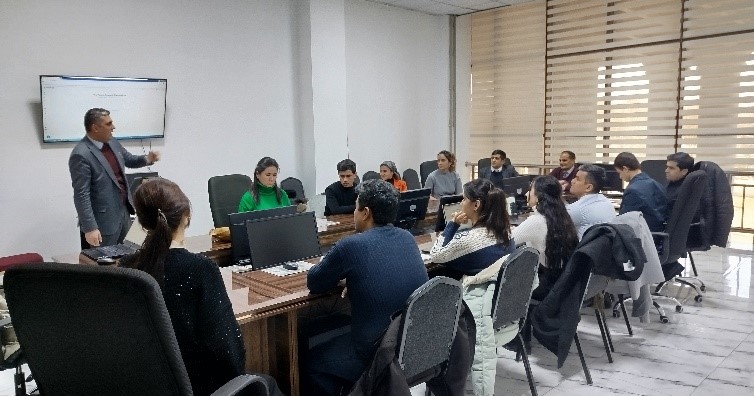
As part of an initiative to develop the professional potential of young scientists, the specialists of the Research Personnel Training Department of the Avicenna Tajik State Medical University organized a seminar for PhD and master’s students on using artificial intelligence and modern digital tools in scientific activities.
The seminar was led by the Chairman of the Youth Department, Mirsafo Mirhakimovich Mirsharofov, who discussed the importance of developing soft skills for successful work in science.
The seminar introduced the capabilities of SciSpace, a tool designed to assist in scientific work. Mirsharofov provided a detailed overview of the platform’s core functionalities, which significantly simplify scientific tasks: Paraphraser — a tool for rephrasing text; AI Detector — for checking text for signs of artificial intelligence usage; Citation Generator — automatic creation of bibliographic references; Literature Review — assistance in conducting literature reviews.
Participants showed great interest in the platform’s paid features, their costs, and limitations. It was noted that up to 5 questions could be asked for free every 3 hours.
Additional resources presented included: SCI-HUB — for accessing scientific articles unavailable on other open-access platforms; Researchrabbit.com — a tool that personalizes literature searches, simplifying the process of finding relevant studies.
Mirsharofov recommended focusing on articles with high citation rates to enhance the quality of scientific publications and enrich literature reviews. Participants were encouraged to register as authors in the DOI system to increase the visibility and authority of their scientific work.
Other recommended resources also recommended for young Scientifics such as: https://www.semanticscholar.org/ — for finding scientific articles on specific topics; https://www.connectedpapers.com/ — for building networks of articles on selected topics.
The seminar sparked active interest among participants, who highlighted the practical value of the presented tools. Such events help young researchers integrate modern technologies into their scientific activities and develop essential skills for successful careers.
Research Personnel Training Department