


THE CONSTITUTION OF THE REPUBLIC OF TAJIKISTAN IS A KEY DOCUMENT THAT LAID THE FOUNDATION FOR STATEHOOD
"The Constitution has created a solid and reliable legal foundation for laying the foundations of a new Tajik statehood, achieving peace and stability, national unity, great political, economic and socio-cultural achievements, developing civil society and freely forming an individual."
Emomali Rahmon
The Constitution plays a huge role in the life of society, occupies a special place in the entire legal system of the state, which causes the need for its comprehensive study as an independent object of scientific knowledge.
Constitutions, in the modern sense of the word, arose at the end of the XVIII century. In the era of feudalism, along with this term, the wording "basic law" was also used, which is now often used as a synonym for the word "constitution"
The Constitution is the basic law of the state, a special normative legal act that has the highest legal force. It enshrines the fundamental principles of the structure of society and the state, determines the foundations of state and public life, the organization of power, and also guarantees the rights and freedoms of man and citizen.
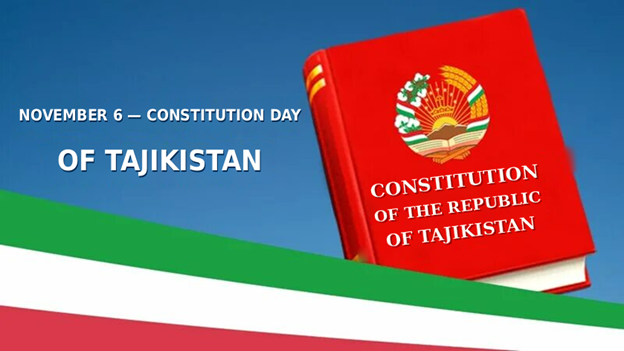
The Constitution of the Republic of Tajikistan was adopted on November 6, 1994 through a national referendum. In the same way, it was amended and supplemented on September 26, 1999, June 22, 2003 and May 22, 2016.
The Constitution of the Republic of Tajikistan, adopted on November 6, 1994, is an important legal and political basis for strengthening statehood and development of the country. The Founder of Peace and National Unity, Leader of the Nation, President of the Republic of Tajikistan, Emomali Rahmon, played a significant role in the formation of this fateful document. The Constitution of the Republic of Tajikistan is the highest legal act, highly appreciated by both domestic and international experts, including specialists from the Russian Federation, the United States and European countries. It is recognized as one of the five best among the member states of the Organization for Security and Cooperation in Europe.
The Constitution of the Republic of Tajikistan, being the Basic Law, defined the legal foundations of the state, the integrity of the country, national interests, the goals of domestic and foreign policy, as well as the social and economic foundations of Tajik society. It became the basis for the creation of legislation compatible with international norms, and set itself the goal of protecting the rights and freedoms of citizens regardless of nationality, region, language and religion.
The document consists of 10 chapters and 100 articles.
Chapter I - "Foundations of the Constitutional System"
Chapter II - "Rights, freedoms and basic duties of a person and a citizen".
Chapters III to IX are devoted to the organization and activities of state bodies: the parliament (Majlisi oli), the President, the government, local authorities, the court, the prosecutor's office, as well as the Gorno-Badakhshan Autonomous Region.
Chapter X regulates the procedure for amending the Constitution.
Key principles and features of the Constitution.
Direct effect of the Constitution. Its norms have supremacy: laws and other legal acts that contradict the Constitution have no legal force.
Priority of international law. International legal acts recognized by Tajikistan are part of the national legal system. If there is a contradiction between them and the laws of the country, the norms of international acts are applied.
A person, his rights and freedoms are the highest value. The Constitution recognizes a person, his rights and freedoms as the starting point, the meaning of the activities of all power structures.
Immutable provisions. Article 100 of the Constitution stipulates that the republican form of government, territorial integrity, as well as the democratic, legal, secular and social essence of the state are not subject to change.
Amendments. Amendments to the Constitution are made by referendum. Previously, amendments were made in 1999 (then the parliament became bicameral) and in 2003 (the term of office of the president was extended).
Significance of the Constitution. The Constitution serves as a legal basis for building an independent Tajik state, expresses the aspirations of national statehood, protects national interests, historical and cultural heritage. November 6 is celebrated as the Constitution Day of the Republic of Tajikistan - a national holiday.
The Founder of Peace and National Unity, Leader of the Nation, President of the Republic of Tajikistan, Emomali Rahmon said: "On November 6, 1994, a great event took place in the history of Tajikistan. For the first time in more than a thousand years of history, the Tajik people adopted the Constitution through a referendum. The active participation of citizens in this process was a victory for democracy in Tajikistan."
The Constitution of the Republic of Tajikistan is the basis of legislation and a stable foundation for the development of a new statehood, ensuring the principles of sovereignty, democracy and law and order in the country.
"The Constitution has strengthened the legal foundations of independence and the foundations of our democratic, legal, secular and social state. The Constitution has become the source of the formation of the legislative system of our modern state and ensured the free and broad participation of citizens in the political and social life of the country and the administration of the state."
Emomali Rahmon
Department of propaedeutics of children's diseases