

PRACTICAL CLASSES IN THE CENTRE FOR SIMULATION TRAINING
"Knowledge is not power until it is applied in practice."
Dale Carnegie
The Center for Simulation Training of the State Educational Institution “Avicenna Tajik State Medical University” was established in 2012. The primary objective of the Center is to develop students' professional practical skills through the application of innovative educational technologies. It is imperative for future doctors to acquire a comprehensive set of knowledge and practical competencies, enabling them to accurately diagnose and implement appropriate treatment measures, even in complex clinical scenarios. This approach ensures that students gain the essential professional skills required for medical practice.
The term “practical skill” refers to the ability to execute a specific task—whether manual, sensory, or cognitive—that constitutes a component of a more complex professional activity performed by a physician. When such a skill is practiced to the point of automation, it is classified as a competence or a refined skill. The ancient Greeks aptly noted, “Much knowledge does not teach intelligence.” Therefore, in medical training, it is critical to create conditions that allow students to repeatedly perform specific actions under supervision, ensuring precision and mastery of their execution.
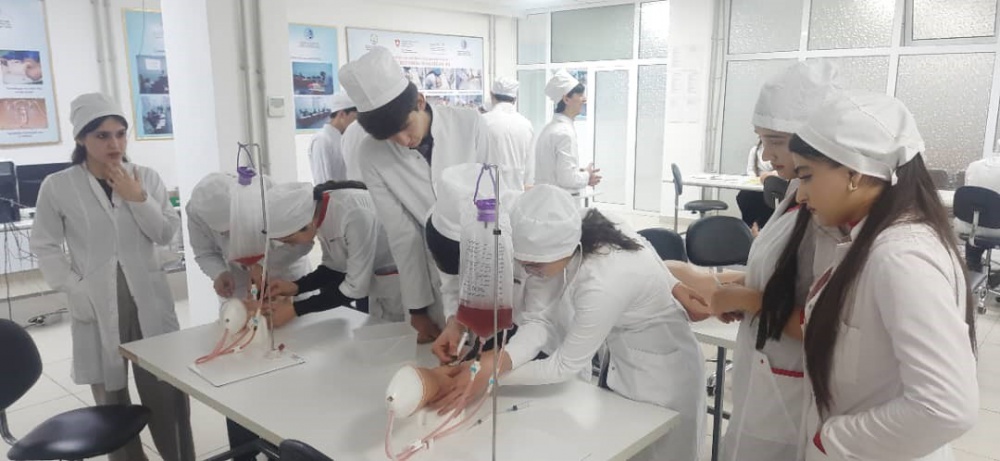
From November 25 to 30, 2024, the department of propaedeutics of children’s diseases conducted practical training sessions for 3rd-year students of the medical and pediatric faculties, as well as 2nd and 3rd -year bachelor’s students at the Center for Simulation Training of Avicenna Tajik State Medical University. During these sessions, students enhanced their practical skills using pediatric mannequins, perinatal mannequins, breast examination simulators, simulators for intramuscular and intravenous injections, the “Harvey” cardiopulmonary simulator, and pediatric ventilation mannequins.
The interdisciplinary training of students through the use of phantoms, mannequins, and simulators significantly improves the quality of their comprehension and application of educational material while minimizing risks during future practical activities.
Department of propaedeutics of children’s diseases
Translated by Ismoilov R.