


CLINICAL CONFERENCE AT THE DEPARTMENT OF PROPAEDEUTICS OF CHILDREN’S DISEASES
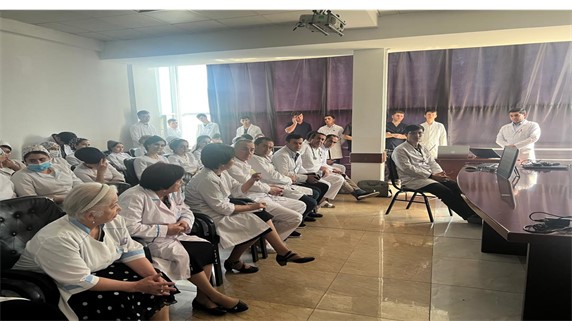
On October 16, 2025, the staff of the Department of propaedeutics of children’s diseases, Avicenna Tajik State Medical University, together with the physicians of the 7th pediatric somatic building of the SI “Istiqlol” Medical Complex, held a clinical conference on the topic: “Irritable bowel syndrome.”
The presentation was prepared by the head of the gastroenterology department, Sharipov Z.Kh. It provided a detailed overview of the etiology, pathogenesis, classification, clinical manifestations, diagnosis, differential diagnosis, and modern methods of treatment of this pathology in children.
Irritable Bowel Syndrome (IBS) is defined as a complex of functional intestinal disorders that include abdominal pain or discomfort relieved after defecation, associated with changes in stool frequency and consistency for at least 3 days per month over the past 3 months within the previous year.
The etiology of IBS is associated with various factors such as stress, personality traits of the child, and a history of intestinal infection, among others.
According to the Rome III Criteria, diagnosis and classification of IBS are based on the predominant stool pattern:
1. IBS with constipation (IBS-C): Hard or lumpy stool (types 1–2) in >25% of bowel movements and loose or watery stool (types 6–7) in <25%, without the use of antidiarrheal or laxative agents.
2. IBS with diarrhea (IBS-D): Loose or watery stool (types 6–7) in >25% of bowel movements and hard or lumpy stool (types 1–2) in <25%, without medication use.
3. Mixed IBS (IBS-M): Hard or lumpy stool in >25% of defecations and loose or watery stool in >25%, without medication use.
4. Unclassified IBS (IBS-U): Insufficient abnormalities in stool consistency to meet the above subtypes.
The Rome III classification provides a unified approach to describing patients whose bowel habits frequently change (constipation alternating with diarrhea). For such cases, the term “Alternating IBS (IBS-A)” has been proposed. Another clinically important form is Post-infectious IBS (PI-IBS), which develops after acute intestinal infections. Although not included in the Rome III consensus, this form has received significant attention from researchers. It was first described more than 50 years ago [G.T. Stewart, 1950]. According to modern data, 7–33% of patients who have experienced intestinal infections develop IBS symptoms within 3–6 months up to 6 years after infection. The Bristol Stool Form Scale is recommended for practical use in such cases.
Symptoms of IBS. Patients typically complain of recurrent abdominal pain or discomfort (a feeling of pressure, distension, or bloating), associated with defecation, changes in stool frequency or character, or other related symptoms.
Extra-gastrointestinal complaints related to neurological and autonomic dysfunctions include headache, lumbar pain, sensation of a lump in the throat, drowsiness or insomnia, dysuria, and menstrual irregularities in girls.
Clinical features of IBS (according to Rome III Criteria):
- Defecation frequency less than 3 times per week or more than 3 times per day;
- Hard/lumpy or soft/watery stool;
- Straining during defecation;
- Urgent defecation (inability to delay bowel movement);
- Sensation of incomplete evacuation;
- Passage of mucus;
- Feeling of fullness, bloating, or abdominal distension.
Symptoms are often aggravated by stressful situations (examinations, arguments, emotional stress, etc.) and must be present for at least 6 months before diagnosis.
Differential Diagnosis. For pediatric patients, the following “alarm” symptoms (Rome III, 2006) exclude IBS:
- unexplained weight loss;
- symptoms persisting during sleep;
- constant severe abdominal pain;
- progressive worsening;
- fever;
- rectal bleeding;
- painless diarrhea;
- steatorrhea;
- intolerance to lactose, fructose, or gluten;
- abnormal laboratory findings.
Differential diagnosis should be made with:
- intestinal infections (bacterial, viral, amoebic);
- inflammatory bowel diseases (ulcerative colitis, crohn’s disease);
- malabsorption syndromes (post-gastrectomy, pancreatic, or enteral);
- cns disorders (fatigue, fear, emotional stress);
- psychopathological conditions (depression, anxiety, panic attacks, somatization);
- neuroendocrine tumors (carcinoid syndrome, vipoma);
- endocrine diseases (thyrotoxicosis);
- functional states (premenstrual syndrome);
- proctoanatomical disorders (pelvic floor dyssynergia, perineal descent syndrome, solitary rectal ulcer);
- adverse food reactions (caffeine, alcohol, fats, milk, vegetables, fruits, black bread, etc.);
- medication side effects (laxatives, iron preparations, bile acid agents).
Treatment. The main goals of therapy are:
- Relief of pain and discomfort;
- Normalization of intestinal motility;
- Improvement of psycho-emotional status.
Treatment is based on the FODMAP diet — a special nutritional protocol designed to reduce gastrointestinal symptoms in disorders such as IBS.
Diet therapy is a key component: regular meals, adequate hydration, and reduction of foods high in lactose, fructose, and sorbitol. For regulation of intestinal motility — trimebutine; for constipation — lactulose, macrogol; for diarrhea — loperamide; for abdominal pain and discomfort — drotaverine hydrochloride, hyoscine butyl bromide, papaverine; for flatulence — simethicone; for depressive states with insomnia, agitation, or anxiety (under psychiatric supervision) — amitriptyline, tofisopam.
Treatment efficacy indicators: absence of pain and dyspeptic syndromes, normalization of intestinal motility and psycho-emotional status, remission, and improved well-being (complete or partial).
The information was presented in slides. Considering the relevance of this pathology in children, the conference concluded with an active discussion and numerous questions.
Department of propaedeutics of children’s diseases