

THE EVOLUTION OF SCIENTIFIC THOUGHT IN THE LEGACY OF АБУАЛӢ ИБНИ СИНО AND IT’S INFLUENCE ON THE DEVELOPMENT OF WORLD SCIENCES
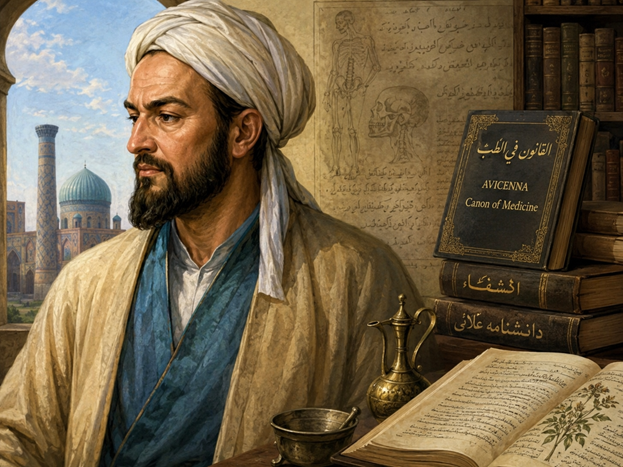
Abuali Ibn Sina, widely known in the West as Avicenna, was a great Tajik philosopher, physician, thinker, and encyclopedic scholar who is regarded as one of the most outstanding intellectuals in the history of human civilization. His remarkable scientific heritage played a significant role in the development of medicine, philosophy, logic, natural sciences, ethics, mathematics, and many other fields of knowledge. Ibn Sina’s scientific legacy possesses immense historical importance not only for the Eastern world but also for Western civilization. During the middle Ages, when the world was experiencing a complex stage of scientific development, Ibn Sina, through his intellect, wisdom, and scientific worldview, succeeded in creating new approaches to knowledge and cognition. His works served for centuries as fundamental sources of learning in the universities of both the East and Europe. His famous masterpiece, The Canon of Medicine, is considered one of the most influential medical works in the history of humanity. The study of Ibn Sina’s scientific heritage remains highly relevant in the modern era. In a time of rapid scientific and technological progress, examining the experience of classical scholars contributes greatly to the development of scientific thinking and human worldview. Ibn Sina’s works represent a valuable scientific source encompassing numerous medical, philosophical, and ethical issues.
Today, the global academic community demonstrates particular interest in the history of science and the role of outstanding scholars. In this context, the study of Ibn Sina’s legacy is essential for understanding the development of world sciences and determining the place of Tajik civilization within global culture.
Abuali Husayn ibn Abdullah ibn Sina was born in 980 in the village of Afshana near Bukhara. From early childhood, he showed extraordinary interest in science and learning. At a young age, he mastered logic, philosophy, mathematics, medicine, literature, and music.
At the age of eighteen, Ibn Sina became renowned as an exceptional physician. Owing to his knowledge and professional skills, he successfully treated the Emir of Bukhara and gained access to the greatest libraries of his time. This experience profoundly influenced the formation of his scientific worldview.
Throughout his lifetime, Ibn Sina authored more than 450 works, many of which were devoted to medicine, philosophy, and natural sciences. Among his most famous works are The Canon of Medicine, The Book of Healing, Danishnama, and Pointers and Reminders. Main Aspects of Ibn Sina’s Scientific Thought.
Philosophical Views. Ibn Sina’s philosophy occupies a special place in the history of human thought. He analyzed the problems of existence, cognition, humanity, and the universe from scientific and logical perspectives. According to him, science is the primary means of discovering truth. Ibn Sina placed great trust in the power of reason and knowledge. He emphasized that through science and research, humanity can comprehend the essence of the universe. These ideas exerted a profound influence on the development of rationalist philosophy. The great thinker also examined the relationship between body and soul. In his view, the soul possesses an independent essence closely connected with intellect and cognition. These ideas significantly contributed to the development of psychology and philosophical anthropology.
Medical Views. Medicine was one of the principal directions of Ibn Sina’s scientific activity. He made an extraordinary contribution to both theoretical and practical medicine. His Canon of Medicine is a comprehensive medical encyclopedia covering anatomy, physiology, diseases, methods of diagnosis, and treatment.
Ibn Sina paid particular attention to disease prevention. He regarded a healthy lifestyle, proper nutrition, and hygiene as essential factors for maintaining health. The scholar also proposed important ideas concerning the influence of the environment on human health. He argued that air, water, food, and psychological conditions significantly affect human well-being.
Natural Scientific Views. Ibn Sina also made remarkable contributions to natural sciences. He investigated the concepts of motion, matter, time, and space while attempting to explain the laws of nature.
Logical Views. Logic occupied an important place in Ibn Sina’s teachings. He regarded logic as the principal instrument of correct thinking and scientific inquiry. His works analyze syllogism, reasoning, and methods of deduction. Ibn Sina’s logical theories greatly influenced the formation of scientific methodology. He attempted to unite logic and empirical experience into a coherent system of scientific cognition. During the Middle Ages, Ibn Sina’s medical works were used as primary textbooks in European universities. The Canon of Medicine was translated into Latin and several other languages and served for centuries as a standard medical reference.
Many diagnostic and treatment methods proposed by Ibn Sina were later improved by modern medicine. He attached great importance to observation, experimentation, and scientific research. Ibn Sina’s philosophical ideas profoundly influenced both Eastern and Western philosophy. European philosophers such as Thomas Aquinas and Albertus Magnus extensively utilized his works. His teachings concerning cognition, existence, and intellect played a crucial role in the development of Scholastic philosophy. Ibn Sina’s natural scientific ideas also influenced the development of physics, astronomy, and chemistry. He devoted considerable attention to investigating the laws of nature. He viewed science as a comprehensive system of knowledge based on experience and logic. This approach later became highly significant in the development of experimental sciences.
Ibn Sina’s Place in World Culture. Today, Ibn Sina’s name is honored throughout the world. His works are studied in numerous universities and scientific institutions.
Universities, streets, medical centers, and research institutions have been named after him, demonstrating the universal significance of his scientific legacy.
In Tajikistan, particular attention is devoted to studying and promoting Ibn Sina’s heritage. His works are regarded as an important part of national history and culture.
Scientific and Ethical Values of Ibn Sina’s Legacy. One of the most important features of Ibn Sina’s teachings is the close relationship between science and morality. He believed that science should serve humanity and society. The scholar considered physicians to be responsible and humane individuals. According to him, a doctor should possess not only professional knowledge but also high moral qualities. These ideas remain relevant today and continue to play an important role in the development of medical ethics.
Analysis of Ibn Sina’s Heritage in the Modern Era. Today, Ibn Sina’s works are studied from scientific, philosophical, and historical perspectives. Researchers seek to explore more deeply his contribution to the development of various sciences.
His writings possess not only historical value but also practical scientific importance. Many of his ideas concerning healthcare, healthy living, and medical ethics remain highly relevant today. Modern research demonstrates that Ibn Sina was one of the founders of scientific methodology. He developed science on the basis of observation, experimentation, and analytical reasoning. Ibn Sina’s scientific legacy is one of the greatest achievements of world civilization. Through his scientific worldview, he made an enormous contribution to medicine, philosophy, logic, and natural sciences. The evolution of Ibn Sina’s scientific thought demonstrates that he regarded science as the primary means of cognition and social progress. His works profoundly influenced the development of world sciences and continue to retain their significance today.
The study of Ibn Sina’s legacy is of great importance for the formation of scientific worldview, moral education, and the advancement of modern science. Therefore, comprehensive research into his works remains one of the most important tasks of the humanities and natural sciences.
Department of Foreign Languages