


CLINICAL CONFERENCE AT THE DEPARTMENT OF PROPAEDEUTICS OF CHILDREN’S DISEASES
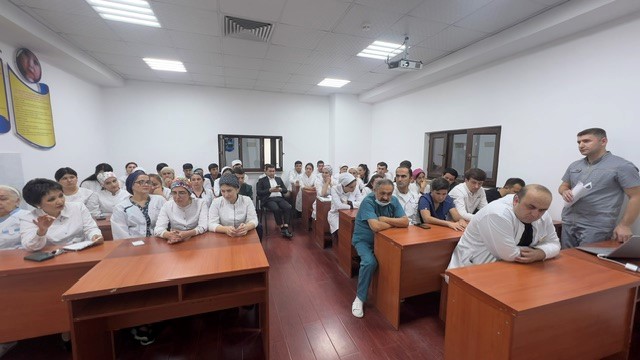
On October 15, 2026, the department of propaedeutics of children's diseases held a clinical conference on "Chronic pancreatitis in children", attended by department staff and physicians of the pediatric somatic building of the S.I. "Istiqlol medical complex". Kuhistonov Sh. G., a part-time member of the department and a physician of the pediatric gastroenterology unit, prepared a presentation on the topic, including an analysis of an interesting clinical case. Many questions were raised and a discussion was held.
Chronic pancreatitis (CP) is an inflammatory-degenerative disease of the pancreas whose pathomorphological basis is inflammation and fibrosis of the parenchyma, with the development of exocrine and endocrine insufficiency of the organ.
Main etiological factors. Chronic pancreatitis in children can be triggered by many factors:
· Congenital or genetic anomalies of the structure of the pancreas and its ducts.
· Hereditary predisposition associated with mutations in genes that regulate pancreatic enzyme function.
· Poor diet: excess fatty, spicy and sugary food, irregular meals, overeating.
· Infectious diseases such as mumps, viral hepatitis and enterovirus infections.
· Helminthic infestations.
· Abdominal trauma.
· Certain medications.
· Systemic diseases (cystic fibrosis, hemolytic uremic syndrome, systemic lupus erythematosus).
· Autoimmune disorders (including those associated with other autoimmune diseases).
Chronic pancreatitis in children is classified by several criteria.
· By origin: primary, secondary, special forms (in cystic fibrosis, hyperparathyroidism, etc.).
· By clinical variant: recurrent, painful, latent.
· By severity: mild, moderate, severe.
· By disease period: exacerbation, subsiding exacerbation, remission.
· By functional state: with impaired exocrine or endocrine function.
· By morphological changes: interstitial (edematous), parenchymal, cystic, calcifying.
Clinical criteria. The clinical picture of CP comprises 4 main syndromes:
· Pain syndrome.
· Dyspeptic syndrome.
· Exocrine insufficiency (with maldigestion and malabsorption).
· Endocrine insufficiency (pancreatogenic diabetes mellitus).
Pain. About 1/4 of cases are asymptomatic in the initial period. Then pain appears in the upper abdomen, which for many years is often the only manifestation of the disease. After 3–10 years, exocrine insufficiency develops, together with the associated dyspeptic syndrome and steatorrhea. Pain usually occurs 40–60 minutes after a heavy, especially fatty meal and lasts from 30 minutes to 3 hours. Less commonly, so-called sphincter pain is seen, related to pathological changes of the sphincter of the hepatopancreatic ampulla. It is located in the right half of the epigastrium, appears early (during the meal) and is often acute. Pain frequently follows cold carbonated drinks. The pain syndrome is most pronounced during exacerbation and usually disappears in remission.
The dyspeptic syndrome in CP includes heartburn, nausea, vomiting (sometimes uncontrollable and bringing no relief) and belching. Many of these complaints are related to concomitant functional disorders of the gastrointestinal tract. Patients may suffer from persistent flatulence (due both to impaired digestion and to paretic disorders of the intestine).
The dyspeptic syndrome can be divided into two main groups of signs. The first is associated with duodenal dyskinesia of the duodenostasis type, for which reflux phenomena are especially typical: nausea, belching, heartburn. The second group is associated with exocrine insufficiency of the gland: inadequate secretion of enzymes and bicarbonates impairs intraluminal hydrolysis in the small intestine, clinically manifesting as diarrhea and weight loss. Short-term diarrhea (1–5 days) is most common and stops with diet and enzyme preparations. Diarrhea often alternates with constipation. As exocrine insufficiency progresses, polyfecalia and stools with a greasy sheen appear. The stool is foul-smelling, sticky and unformed.
Weight loss is a common symptom of chronic pancreatitis in children.
Occasionally, children develop clinical signs of fat-soluble vitamin deficiency: subcutaneous hemorrhages (vitamin K deficiency), bone pain (vitamin D deficiency), hemeralopia (vitamin A deficiency).
Symptoms of diabetes mellitus (thirst, dry mouth, polyuria) appear when endocrine insufficiency of the pancreas develops. In CP they appear late, usually 15 or more years after onset, and are therefore rare in children. This type of diabetes (pancreatogenic) has certain features: it often runs with hypoglycemia (in response to insulin or fasting), requires small doses of insulin and is rarely accompanied by ketoacidosis. Patients tolerate significant hyperglycemia fairly well.
Diagnostic investigations. Main diagnostic investigations performed at the inpatient level: complete blood count and urinalysis; blood biochemistry (AST, ALT, bilirubin, alkaline phosphatase, alpha-amylase, glucose, glucose tolerance test); urine alpha-amylase; coprogram (stool analysis); abdominal ultrasound; esophagogastroduodenoscopy (EGD).
Additional diagnostic investigations performed at the inpatient level: blood biochemistry (lipase, cholesterol); abdominal CT; abdominal MRI; abdominal fluoroscopy; stool examination for helminths and protozoa; fecal pancreatic elastase-1; immunological tests.
Treatment. Therapy is selected individually, taking into account the cause and stage of the disease.
Main principles:
· A gentle diet with restricted fat and exclusion of irritating foods.
· Hydration (fluid replacement).
· Pain relief.
· Suppression of pancreatic secretion.
· Enzyme replacement therapy when exocrine insufficiency develops (pancreatic enzyme preparations).
During remission, strict adherence to the diet and regular follow-up with a gastroenterologist are essential. Additional courses of treatment are prescribed when necessary.
Complications. Without treatment, chronic pancreatitis can lead to serious consequences:
· pseudocysts, calcifications, fistulas;
· cholestasis (bile stasis);
· ascites (fluid accumulation in the abdominal cavity);
· pleurisy;
· pancreatogenic diabetes mellitus;
· malabsorption syndrome (impaired absorption of nutrients in the intestine).
Prognosis. With timely diagnosis and proper treatment, stable remission can be achieved and the child's quality of life significantly improved. Without therapy, however, the disease progresses and the risk of complications increases.
Department of propaedeutics of children's diseases